
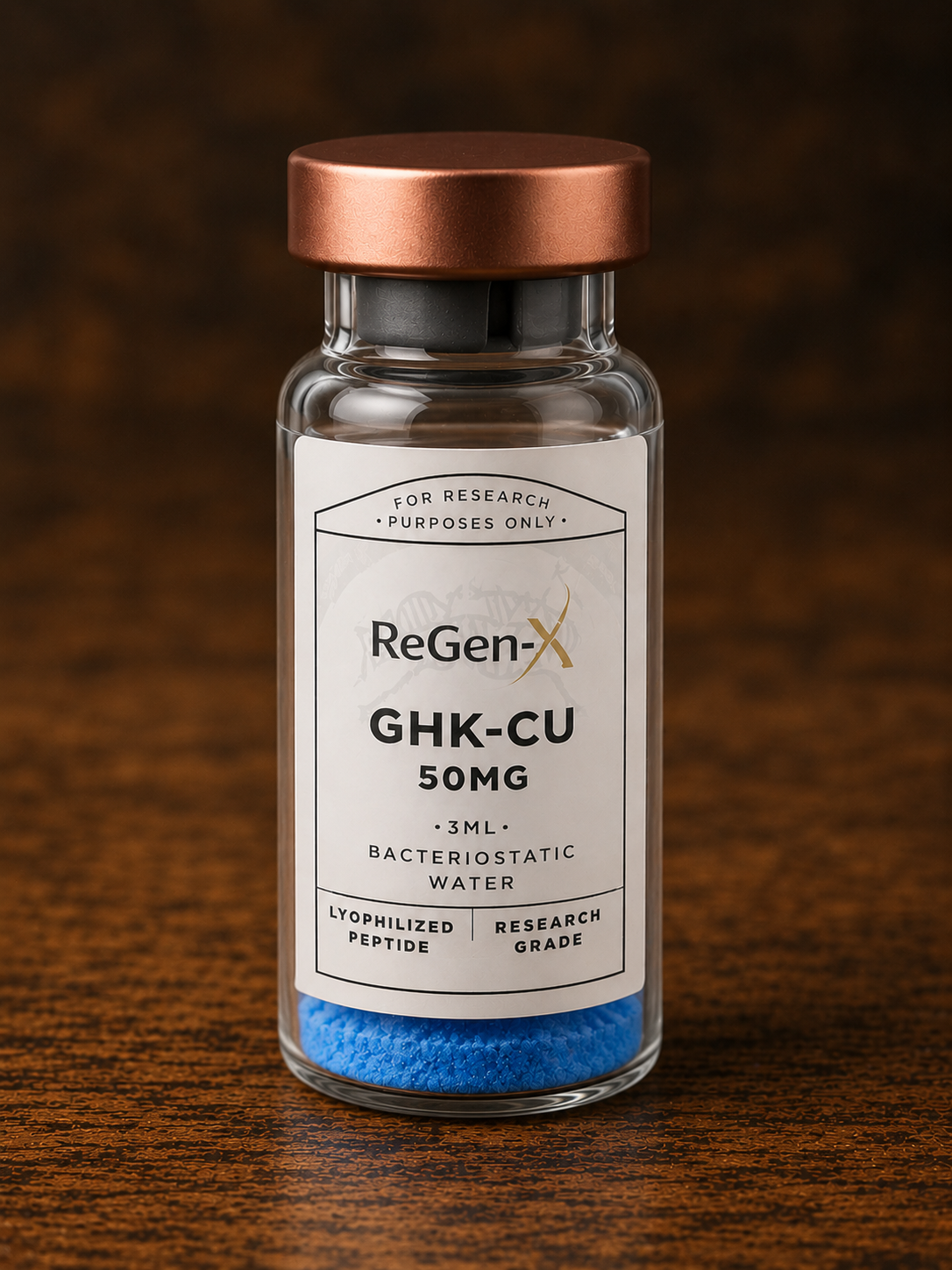
GHK-Cu Peptide: Everything You Need to Know
If you’ve been researching GHK-Cu, you’ve likely seen it described as one of the most exciting regenerative peptides available today. From premium skincare products to research into wound healing, hair restoration, and healthy aging, GHK-Cu peptide has gained significant attention for its broad range of biological activities.
Unlike many peptides that target a single receptor or pathway, GHK-Cu appears to influence hundreds of genes involved in tissue repair, collagen production, inflammation, and cellular regeneration. This broad activity has made it one of the most extensively studied copper peptides in regenerative medicine.
Originally identified in human plasma in the 1970s, GHK-Cu is naturally present in the body. However, its concentration declines with age, leading researchers to investigate whether restoring GHK-Cu levels may help support healthier skin, stronger connective tissue, improved wound healing, and healthier hair follicles.
In this guide, we’ll explore:
- What GHK-Cu is
- How GHK-Cu works
- GHK-Cu benefits
- GHK-Cu for skin
- GHK-Cu for hair growth
- GHK-Cu and collagen production
- GHK-Cu for wound healing
- Anti-aging potential
- Current scientific research
- Safety considerations
- Frequently asked questions
Whether you’re new to peptide research or looking to expand your understanding of regenerative medicine, this guide covers everything currently known about GHK-Cu.
What Is GHK-Cu?
GHK-Cu stands for Glycyl-L-Histidyl-L-Lysine Copper, a naturally occurring tripeptide that binds to copper ions. This complex is found naturally in human plasma, saliva, and urine and plays an important role in tissue maintenance and repair.
As one of the body’s naturally occurring signaling molecules, GHK-Cu helps regulate biological processes involved in healing and regeneration. Because its levels decline over time, researchers believe this reduction may contribute to slower recovery, reduced collagen production, and visible signs of aging.
Today, GHK-Cu is widely studied for its potential roles in:
- Skin rejuvenation
- Collagen production
- Hair growth
- Tissue repair
- Scar healing
- Connective tissue health
- Wound healing
- Healthy aging
- Cosmetic dermatology
Its unique ability to influence multiple repair pathways distinguishes it from many other peptides under investigation.
The History of GHK-Cu
GHK was first identified by researcher Dr. Loren Pickart in the early 1970s. During experiments involving human plasma, scientists discovered that this naturally occurring peptide appeared to restore more youthful behavior in aged cells.
Later research revealed that GHK binds strongly to copper, forming GHK-Cu, the biologically active complex now used extensively in laboratory studies.
Over the decades, research has expanded from laboratory cell models to investigations involving skin aging, wound healing, cosmetic dermatology, and hair biology. Although many findings remain preliminary, GHK-Cu has earned a reputation as one of the most promising molecules in regenerative science.
How Does GHK-Cu Work?
Unlike hormones that activate a single receptor, GHK-Cu acts more like a biological messenger.
Research suggests it may influence hundreds of genes involved in tissue repair and cellular maintenance. Scientists believe GHK-Cu helps coordinate multiple regenerative processes simultaneously, including:
Collagen synthesis
Collagen provides structure and strength to the skin, tendons, ligaments, and connective tissue. Laboratory research suggests GHK-Cu may stimulate collagen production by supporting fibroblast activity.
Elastin production
Elastin allows skin to stretch and return to its original shape. Healthy elastin contributes to firm, resilient skin.
Fibroblast stimulation
Fibroblasts are specialized cells responsible for producing collagen, elastin, and components of the extracellular matrix. Supporting fibroblast function is essential for tissue repair.
Extracellular matrix remodeling
The extracellular matrix acts as the structural framework surrounding cells. Healthy remodeling supports stronger, more resilient tissue.
Angiogenesis
Research suggests GHK-Cu may encourage the formation of new blood vessels, helping deliver oxygen and nutrients to healing tissue.
Anti-inflammatory signaling
Laboratory studies indicate GHK-Cu may help regulate inflammatory responses that influence tissue repair.
Antioxidant activity
Oxidative stress contributes to aging and cellular damage. GHK-Cu has demonstrated antioxidant activity in several experimental models.
Together, these effects explain why GHK-Cu continues to attract attention in regenerative medicine.
GHK-Cu Benefits
1. Supports Healthy Collagen Production
One of the best-known GHK-Cu benefits is its potential role in collagen synthesis.
Collagen is the most abundant protein in the human body and provides structural support to:
- Skin
- Tendons
- Ligaments
- Cartilage
- Blood vessels
- Bones
- Connective tissue
Beginning in early adulthood, collagen production naturally declines each year. This gradual reduction contributes to:
- Wrinkles
- Fine lines
- Sagging skin
- Reduced elasticity
- Slower wound healing
Research suggests GHK-Cu may encourage fibroblasts to produce new collagen, potentially supporting healthier connective tissue and more youthful-looking skin.
Why Is Collagen So Important?
Collagen influences nearly every aspect of skin quality.
Healthy collagen contributes to:
- Firmer skin
- Improved elasticity
- Better hydration
- Reduced wrinkles
- Faster tissue repair
- Stronger connective tissue
- Improved skin texture
Because collagen loss accelerates with age, many researchers consider supporting collagen production one of the primary goals of regenerative skincare.
GHK-Cu for Skin Rejuvenation
Perhaps the most well-known application of GHK-Cu is skin health.
Modern premium skincare brands frequently include copper peptides because laboratory research suggests they may support healthier skin through several complementary mechanisms.
Potential benefits include:
- Improved skin texture
- Reduced roughness
- Increased firmness
- Better elasticity
- Enhanced hydration
- Improved tone
- Reduced appearance of wrinkles
- Healthier-looking skin
Rather than acting as a temporary cosmetic ingredient, GHK-Cu is being investigated for its ability to support the biological processes that help maintain skin quality.
Can GHK-Cu Reduce Wrinkles?
Wrinkles develop due to a combination of factors, including:
- Collagen loss
- Elastin degradation
- Sun exposure
- Oxidative stress
- Repeated facial movement
- Natural aging
Because GHK-Cu may support collagen and elastin production, researchers continue to study whether it can improve the appearance of fine lines and wrinkles over time.
Although additional clinical studies are needed, early findings have contributed to its popularity in anti-aging skincare formulations.
GHK-Cu and Skin Elasticity
Healthy skin remains flexible because of two key proteins:
- Collagen
- Elastin
As these proteins decline, skin gradually loses firmness.
Research suggests GHK-Cu may help support the cells responsible for maintaining these structural proteins, contributing to improved skin elasticity and resilience.
Many dermatology-focused formulations combine copper peptides with ingredients such as hyaluronic acid, niacinamide, and antioxidants to support overall skin health.
GHK-Cu for Scar Healing
Researchers have also investigated GHK-Cu’s potential role in scar quality.
Laboratory findings suggest it may help regulate the balance between collagen formation and tissue remodeling during healing.
This has led scientists to explore GHK-Cu in relation to:
- Acne scars
- Surgical scars
- Cosmetic procedure recovery
- Skin resurfacing
- Minor wound repair
Rather than eliminating scars, current research focuses on whether GHK-Cu may help support healthier tissue remodeling as wounds heal.
GHK-Cu and Wound Healing
One of the earliest areas of GHK-Cu research involved wound healing.
Successful tissue repair requires a coordinated sequence of biological events:
- Control inflammation
- Remove damaged tissue
- Build new blood vessels
- Produce collagen
- Remodel the extracellular matrix
Laboratory studies suggest GHK-Cu may influence several of these stages, making it an important molecule in regenerative research.
Scientists continue to investigate its role in improving the quality and efficiency of tissue repair in preclinical and early clinical settings.
Why Researchers Call GHK-Cu a Regenerative Peptide
The term regenerative peptide refers to molecules that support the body’s natural repair processes.
Unlike compounds designed to mask symptoms, regenerative peptides are studied for their ability to influence cellular signaling involved in tissue maintenance.
GHK-Cu has become one of the best-known regenerative peptides because research suggests it may affect:
- Collagen production
- Fibroblast activity
- Blood vessel formation
- Skin regeneration
- Connective tissue repair
- Extracellular matrix remodeling
- Healthy inflammatory responses
Its broad biological activity makes it unique among many peptides currently under investigation.
GHK-Cu and Healthy Aging
One of the most fascinating discoveries about GHK-Cu is that natural levels decline significantly with age.
Researchers have proposed that this reduction may contribute to:
- Reduced collagen production
- Slower healing
- Visible skin aging
- Reduced skin elasticity
- Declining tissue quality
This has led scientists to investigate whether supporting GHK-Cu pathways may contribute to healthier aging.
It is important to note that research remains ongoing, and while laboratory findings are promising, more large-scale human clinical trials are needed before firm conclusions can be drawn.
Current Scientific Interest
Today, GHK-Cu continues to be studied across multiple disciplines, including:
- Cosmetic dermatology
- Skin regeneration
- Tissue engineering
- Regenerative medicine
- Hair biology
- Healthy aging
- Biomaterials research
- Wound care
- Connective tissue biology
Its ability to influence multiple repair pathways has made it one of the most extensively researched naturally occurring peptides in modern regenerative science.
GHK-Cu for Hair Growth
One of the fastest-growing areas of GHK-Cu research is its potential role in supporting hair growth and improving hair follicle health. Hair loss affects millions of people worldwide, and researchers continue to investigate how copper peptides may contribute to a healthier scalp environment.
Unlike treatments that focus on a single hormonal pathway, GHK-Cu is being studied for its ability to support the biological environment surrounding hair follicles.
How Hair Growth Works
Hair grows in three main phases:
Anagen (Growth Phase)
The active growth phase, lasting anywhere from two to seven years.
Catagen (Transition Phase)
A short period where the hair follicle begins shrinking.
Telogen (Resting Phase)
The follicle rests before the hair naturally sheds and new growth begins.
Researchers are investigating whether GHK-Cu may help support follicles during the anagen phase while promoting a healthier scalp environment.
How GHK-Cu May Support Hair Health
Current research suggests GHK-Cu may help:
- Improve scalp health
- Support healthy hair follicles
- Encourage blood vessel formation around follicles
- Reduce inflammatory signaling
- Promote extracellular matrix remodeling
- Improve collagen surrounding hair follicles
- Support healthier hair density
- Encourage stronger hair strands
Because healthy follicles rely on adequate oxygen, nutrients, and connective tissue support, GHK-Cu has become an important area of investigation within cosmetic dermatology.
GHK-Cu for Hair Loss
Hair loss can result from multiple factors, including:
- Genetics
- Aging
- Hormonal influences
- Chronic inflammation
- Oxidative stress
- Nutritional deficiencies
- Scalp damage
Researchers continue studying GHK-Cu to determine whether supporting the scalp’s natural repair processes may contribute to healthier hair growth.
Although preliminary findings are encouraging, additional human clinical trials are required before definitive conclusions can be made regarding its effectiveness for different types of hair loss.
GHK-Cu and Exercise Recovery
Recovery is one of the most important aspects of physical performance.
Every workout creates microscopic damage to muscle fibers and connective tissue. Recovery involves repairing this tissue so it can adapt and become stronger.
Researchers are investigating whether GHK-Cu may support recovery through its effects on:
- Connective tissue repair
- Collagen synthesis
- Blood vessel formation
- Healthy inflammatory responses
- Tissue remodeling
These biological processes have made GHK-Cu an area of interest in sports science and regenerative medicine.
Connective Tissue Health
Connective tissue includes:
- Tendons
- Ligaments
- Fascia
- Cartilage
- Skin
- Blood vessels
Healthy connective tissue depends heavily on collagen production and extracellular matrix integrity.
Laboratory studies suggest GHK-Cu may help regulate genes involved in maintaining these structures, though more clinical research is needed to determine how these findings translate to people.
GHK-Cu for Wound Healing
Wound healing is one of the earliest and most extensively studied applications of GHK-Cu.
Healing occurs in several overlapping stages:
1. Hemostasis
The body stops bleeding by forming a clot.
2. Inflammation
Immune cells remove damaged tissue and reduce infection risk.
3. Proliferation
New blood vessels form while fibroblasts produce collagen and extracellular matrix proteins.
4. Remodeling
The repaired tissue strengthens and reorganizes over time.
Research suggests GHK-Cu may influence several of these phases by supporting collagen production, fibroblast activity, and tissue remodeling.
GHK-Cu in Cosmetic Dermatology
Copper peptides have become increasingly common in premium skincare products because they are being investigated for their ability to improve multiple aspects of skin quality simultaneously.
Potential research areas include:
- Skin firmness
- Wrinkle appearance
- Skin texture
- Elasticity
- Hydration
- Acne scar healing
- Sun-damaged skin
- Cosmetic procedure recovery
Rather than providing an immediate cosmetic effect, GHK-Cu is studied for supporting the biological processes that maintain healthy skin.
GHK-Cu and Oxidative Stress
Oxidative stress occurs when free radicals outnumber the body’s antioxidant defenses.
Over time, oxidative stress contributes to:
- Skin aging
- Collagen breakdown
- Cellular damage
- Chronic inflammation
- Reduced tissue repair
Laboratory studies suggest GHK-Cu may influence antioxidant pathways that help protect cells from oxidative damage, although further human research is needed to clarify these effects.
Topical vs Injectable GHK-Cu
Researchers have investigated GHK-Cu using several delivery methods.
Topical GHK-Cu
Commonly found in:
- Serums
- Creams
- Anti-aging skincare
- Hair products
Topical formulations are primarily studied for localized effects on the skin and scalp.
Potential Research Areas
- Skin rejuvenation
- Fine lines
- Wrinkles
- Skin hydration
- Hair follicles
- Scalp health
Injectable GHK-Cu
Injectable GHK-Cu has also been explored in research settings for broader systemic investigation.
Because optimal dosing, frequency, and long-term outcomes have not been established, these applications remain an active area of research rather than standard medical practice.
GHK-Cu Compared with Other Popular Peptides
GHK-Cu vs BPC-157
| GHK-Cu | BPC-157 |
|---|---|
| Focuses on skin, collagen, connective tissue, and cosmetic research | Primarily researched for tendon, ligament, gut, and soft tissue healing |
| Widely used in cosmetic science | Widely discussed in regenerative research |
| Strong emphasis on skin quality | Strong emphasis on musculoskeletal healing |
GHK-Cu vs TB-500
| GHK-Cu | TB-500 |
| Supports collagen production and skin biology | Investigated for cell migration and tissue repair |
| Frequently used in skincare research | Frequently studied for recovery research |
| Strong cosmetic focus | Strong recovery focus |
GHK-Cu vs Growth Hormone
Although both are associated with tissue repair, they work through very different biological pathways.
Growth hormone primarily influences IGF-1 signaling, while GHK-Cu functions as a naturally occurring copper-binding peptide involved in tissue remodeling and gene regulation.
Current Scientific Research
Over the past several decades, GHK-Cu has been investigated in areas including:
- Skin regeneration
- Hair biology
- Cosmetic dermatology
- Tissue engineering
- Connective tissue biology
- Healthy aging
- Wound care
- Biomaterials
Many laboratory findings are promising, but researchers continue to emphasize the need for larger, well-designed human clinical trials to better understand effectiveness, optimal use, and long-term safety.
Safety and Side Effects
Published studies generally report a favorable safety profile for GHK-Cu in research settings.
Potential side effects reported in some studies include:
- Temporary redness
- Mild irritation
- Injection-site discomfort (where applicable)
- Short-term skin sensitivity
As with many investigational peptides, optimal dosing strategies and long-term outcomes remain under study.
Frequently Asked Questions
What is GHK-Cu?
GHK-Cu is a naturally occurring copper-binding tripeptide involved in tissue repair, collagen production, and skin regeneration.
What does GHK-Cu stand for?
GHK-Cu stands for Glycyl-L-Histidyl-L-Lysine Copper.
Is GHK-Cu a peptide?
Yes. It is a naturally occurring tripeptide found in the human body.
Is GHK-Cu good for skin?
Research suggests GHK-Cu may support collagen production, improve skin quality, and contribute to healthier skin appearance.
Can GHK-Cu improve wrinkles?
Early studies suggest GHK-Cu may help support the biological processes involved in maintaining skin firmness and elasticity, though more clinical research is needed.
Does GHK-Cu help hair growth?
Researchers continue investigating whether GHK-Cu supports healthier hair follicles and scalp health. Larger clinical trials are still needed.
Is GHK-Cu natural?
Yes. GHK-Cu naturally occurs in the human body, although its concentration decreases with age.
Why is GHK-Cu called a copper peptide?
The peptide binds strongly to copper ions, creating a biologically active complex involved in tissue repair and regeneration.
Can GHK-Cu support wound healing?
Research suggests GHK-Cu may influence collagen production, fibroblast activity, and tissue remodeling, making it an important molecule in wound healing research.
Is GHK-Cu anti-aging?
Because it is associated with collagen production and skin regeneration, GHK-Cu is widely studied in healthy aging and cosmetic dermatology research.
Internal Linking Opportunities
Strengthen your site’s topical authority by linking this article to related content, including:
- Retatrutide Guide
- Ipamorelin Guide
- BPC-157 Guide
- TB-500 Guide
- Tesamorelin Guide
- CJC-1295 Guide
- GHRP-6 Guide
- Semaglutide Guide
- Tirzepatide Guide
- Peptide Reconstitution Guide
- Peptide Storage Guide
- Peptide FAQ
- Peptide Safety Guide
External Authority Sources
For readers seeking additional scientific information, consider linking to reputable resources such as:
- PubMed https://pubmed.ncbi.nlm.nih.gov/?term=ghk-cu
- National Center for Biotechnology Information (NCBI) https://www.ncbi.nlm.nih.gov/search/all/?term=ghk-cu
Final Thoughts
GHK-Cu remains one of the most extensively researched naturally occurring peptides in regenerative science. Its potential roles in collagen production, skin rejuvenation, hair follicle health, connective tissue repair, and healthy aging continue to make it a molecule of significant scientific interest.
While many laboratory and early clinical findings are encouraging, research is still evolving. Future studies will help clarify the full therapeutic potential of GHK-Cu and determine where it may fit into evidence-based approaches to skin health, tissue repair, and regenerative medicine.
Whether your interest lies in cosmetic science, longevity research, or connective tissue biology, GHK-Cu stands out as one of the most promising copper peptides currently under investigation.
Disclaimer:* This article is intended for educational and informational purposes only. Ipamorelin is a research compound and is not approved in many jurisdictions for the treatment of medical conditions. Research surrounding its efficacy and long-term safety is ongoing.*